Implementing Campus-Wide Mental Health First Aid Training: A Practical Guide
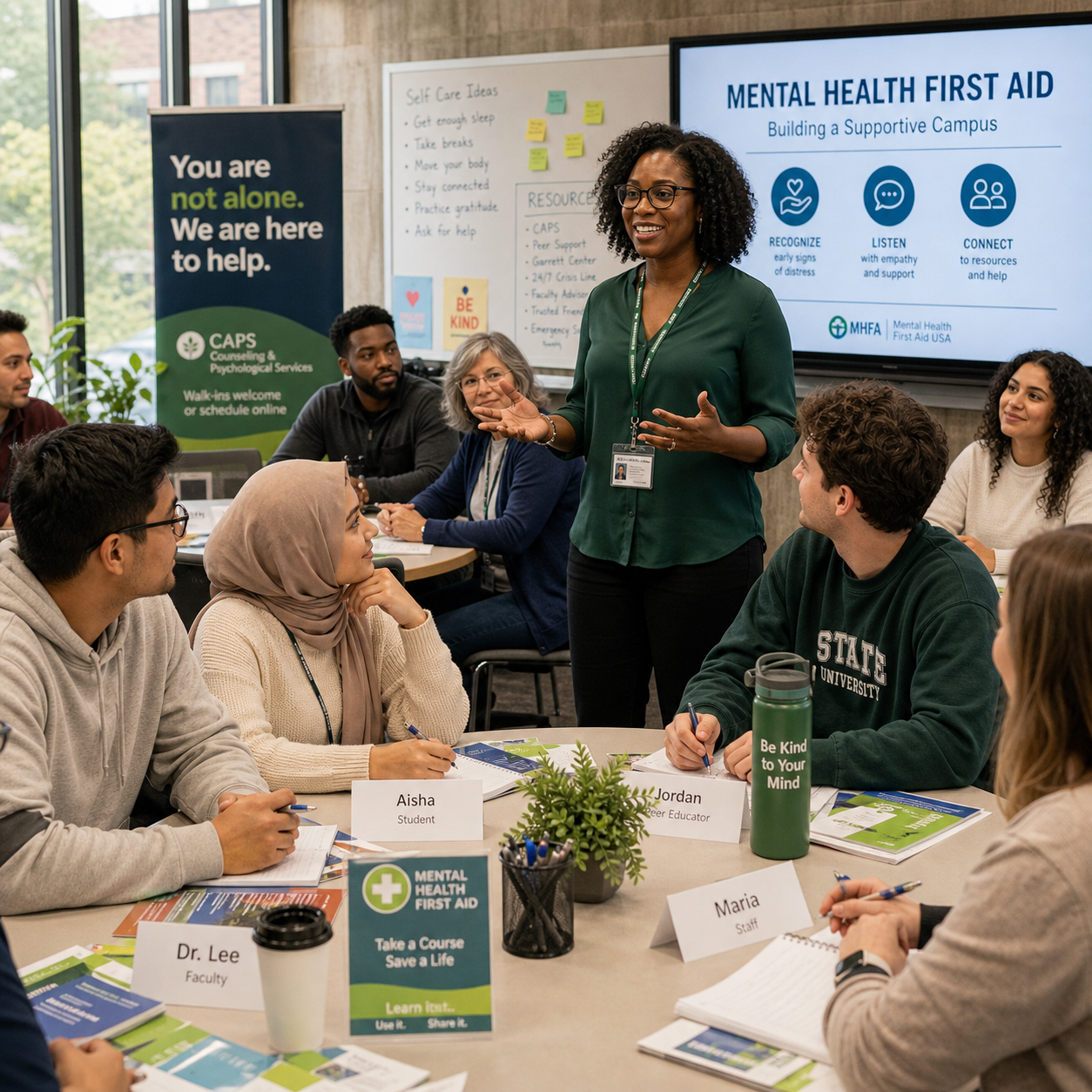
Campus-wide mental health first aid training gives students, faculty, and staff a shared framework for recognizing distress, listening safely, and connecting people with appropriate support. A successful program combines practical training with strong campus health promotion, clear referral pathways, and coordinated crisis response.
What Mental Health First Aid Means on a College Campus
Mental Health First Aid teaches people how to notice possible mental health or substance-use concerns, offer initial support, and guide someone toward professional or community resources. It complements campus counseling services and suicide prevention efforts; it does not replace counseling, psychiatric care, diagnosis, or emergency response.
On a college campus, trained participants may notice changes such as prolonged isolation, sudden academic difficulties, substance-related concerns, panic symptoms, or comments suggesting hopelessness. Their role is to approach with respect, ask open questions, listen without judgment, and help the person identify a next step.
Training should make boundaries explicit. A participant is not expected to determine whether someone has depression, assess complex clinical risk alone, or provide ongoing therapy. In an urgent situation involving immediate danger, a medical emergency, or a serious suicide risk, the person should follow campus crisis procedures and contact emergency services when appropriate.
A useful way to explain the role is the notice, respond, connect model:
- Notice: Recognize meaningful changes or warning signs without labeling or diagnosing.
- Respond: Use calm, compassionate communication and ask directly about safety when concerns warrant it.
- Connect: Share accurate information about counseling, crisis response, peer support, health services, and community care.
Build a Campus-Wide Implementation Plan
To build a campus-wide implementation plan, begin with a needs assessment, define measurable objectives, identify priority audiences, and assign institutional responsibility. A phased rollout is usually more sustainable than attempting to train the entire campus at once.
Start by reviewing existing information, such as counseling utilization trends, student health surveys, residence-life reports, faculty concerns, crisis call data, and feedback from student organizations. Protect privacy and use aggregated information. The purpose is to identify gaps in awareness and access, not to profile individuals or stigmatize particular groups.
Set objectives that describe both reach and capability. For example, a first-year plan might aim to train resident assistants, academic advisers, student leaders, athletics personnel, and selected faculty and staff, while increasing awareness of the campus counseling referral process. Avoid promising that training alone will reduce crises. Training is one layer within a broader prevention and support system.
Establish a steering group with authority to make decisions. It may include campus health promotion, counseling services, student affairs, residential life, disability services, academic departments, risk management, communications, and student representatives. Give the group a written charter covering budget, training standards, data governance, referral updates, and escalation responsibilities.
Budget for facilitator fees, participant materials, accessible venues, online learning tools, staff release time, interpretation, evaluation, and refresher activities. A low-cost rollout can still fail if no one owns scheduling, resource updates, or follow-up. Assign a program coordinator and document who maintains the referral directory.
Engage Key Campus Stakeholders
Stakeholder collaboration makes mental health first aid part of campus infrastructure rather than a one-time workshop. Health promotion teams can coordinate the program, while counseling services and crisis professionals define safe referral and escalation practices.
Each partner brings a different point of contact with the campus community:
- Campus counseling services: Confirm eligibility, appointment routes, urgent-care procedures, after-hours contacts, and limits on confidentiality.
- Student affairs and residential life: Prepare resident assistants, orientation leaders, student conduct staff, and case managers for common student-facing situations.
- Academic departments: Help faculty and advisers respond to academic distress without turning teaching staff into clinicians.
- Student organizations and peer support groups: Shape culturally relevant messaging and identify barriers that administrators may miss.
- Disability and accessibility services: Review materials, venues, technology, and participation options for access needs.
- Human resources and employee assistance partners: Support faculty and staff while keeping employee privacy and workplace boundaries clear.
Invite students and staff with lived experience to advise on language, examples, and potential harms. Participation should be voluntary, compensated when possible, and designed to avoid asking anyone to disclose personal experiences. A stakeholder map can clarify influence, responsibility, and communication routes before implementation begins.
Design an Accessible Training Rollout
To design an accessible rollout, segment audiences by role, offer more than one delivery format, and remove practical, cultural, and emotional barriers to participation. The same training schedule and examples will not work equally well for students, faculty, staff, commuters, graduate researchers, and residential-life teams.
Match training to audience and context
Resident assistants may need practice with late-night conversations and emergency escalation. Faculty may need guidance on responding to concerning messages while protecting academic boundaries. Student leaders may benefit from role-play focused on peer support and referral conversations. Supervisors require additional information about workplace resources and privacy.
Use a blend of in-person workshops, shorter modules, orientation sessions, and carefully designed online components. In-person practice supports discussion and confidence, while asynchronous content can reach commuters and employees with limited availability. The trade-off is important: flexible delivery improves access, but highly compressed training may provide less opportunity to rehearse difficult conversations.
Plan for inclusion and accessibility
Offer sessions at varied times, provide captions and accessible digital materials, choose physically accessible rooms, and make language support available where feasible. Explain content involving suicide, self-harm, trauma, or substance use in advance. Allow participants to step out without penalty and provide support information at the beginning and end of each session.
Use examples that reflect different cultures, identities, ages, family structures, and disability experiences. Avoid framing one communication style as the universal sign of distress. Training should also address consent: participants can offer support, but they cannot force a disclosure or guarantee confidentiality when safety concerns require escalation.

Connect Training to Campus Support Systems
Training becomes useful when every participant can explain what to do next, whom to contact, and how urgent concerns are handled. Build a simple referral pathway that connects recognition and conversation to campus counseling services, health services, peer support, crisis response, and community resources.
Create a one-page decision guide with three levels:
- Immediate danger: Stay with the person when safe, contact the designated crisis or emergency service, and follow campus protocols for suicide prevention and medical emergencies.
- Significant concern without immediate danger: Listen, ask what support the person wants, offer counseling or health-service options, and arrange a warm referral when appropriate.
- Early or uncertain concern: Share resources, encourage follow-up, and check in within an agreed boundary without taking responsibility for treatment.
Make referral information easy to find in learning platforms, residence halls, syllabi, staff portals, student apps, and printed materials. Include office hours, appointment methods, after-hours options, accessibility details, language availability, and what happens during a first contact. Update the information each term because phone numbers, staffing, and service eligibility change.
Teach participants to avoid promises such as keeping a safety threat secret. They should explain limits clearly, document only through approved systems, and share the minimum necessary information with the appropriate professional or emergency contact. This protects the person seeking help and the trainee.
Promote Participation and Campus Engagement
Campuses encourage participation when they present mental health first aid as a practical community skill, make enrollment convenient, and use trusted messengers. Communication should reduce stigma without relying on fear or suggesting that trainees are responsible for preventing every crisis.
Use a coordinated campaign across orientation, residence life, advising, athletics, employee communications, student media, and campus events. Describe specific benefits: learning how to start a difficult conversation, finding the right referral, and responding when someone may be unsafe. Student ambassadors and peer educators can make the invitation more credible, particularly when they help tailor examples and timing.
Faculty involvement works best when departments offer protected time and explain the boundary between academic support and clinical care. For students, consider incentives such as recognition certificates, leadership development credit, co-curricular records, or meals, while keeping the program voluntary and avoiding incentives that pressure people to discuss personal experiences.
Track participation by audience and access need, using only data necessary for program planning. If attendance is low among commuter students or evening staff, change the format rather than assuming a lack of interest. Visibility also matters after training: place referral cards in common areas and include short reminders during high-pressure periods such as examinations and transitions between terms.
Evaluate and Sustain the Program
Evaluate the program by measuring reach, learning, confidence, referral awareness, participant experience, and system-level follow-through over time. Attendance alone shows exposure, not whether participants can respond safely or locate appropriate support.
Use a short evaluation sequence:
- Record registrations, attendance, completion, audience type, delivery format, and basic access information.
- Measure knowledge before and after training, including recognition of warning signs, boundaries, and escalation procedures.
- Ask participants to rate confidence in listening, asking about safety, and making a referral.
- Test referral knowledge with practical questions, such as how to reach counseling after hours.
- Collect feedback on cultural relevance, accessibility, emotional safety, facilitation, and usefulness.
- Review aggregated trends with the steering group and use them to adjust content, scheduling, and support pathways.
Do not interpret increased referrals automatically as program failure. Better awareness may lead people to seek help earlier. Likewise, a drop in reported confidence may indicate that participants better understand the complexity of crisis response. Pair training data with service-capacity information so increased awareness does not overwhelm an under-resourced counseling system.
Sustainability requires facilitator development, annual resource checks, refresher opportunities, onboarding for new resident assistants and employees, and regular student input. Keep a change log for emergency contacts and referral services. A program that receives quarterly maintenance is more dependable than one promoted heavily during a single awareness week.
Frequently Asked Questions
Who should receive campus mental health first aid training?
Priority groups often include resident assistants, advisers, faculty, student leaders, coaches, supervisors, health promotion staff, and employees who regularly support students. Over time, campuses can offer opportunities to the wider student and employee population.
How does mental health first aid differ from counseling or crisis intervention?
Mental Health First Aid provides initial recognition, conversation, and referral skills. Counseling provides professional assessment and treatment, while crisis intervention addresses urgent safety or stabilization needs through trained clinical or emergency responders.
How can campuses encourage students and staff to participate?
Offer varied schedules and formats, use trusted peer and faculty messengers, provide accessible materials, connect participation to leadership development, and explain the practical skills participants will gain.
What resources are needed to implement the program?
Core resources include leadership sponsorship, a coordinator, trained facilitators, a budget, accessible venues or technology, current referral information, crisis procedures, communications support, and an evaluation process.
How should a campus evaluate training effectiveness?
Combine reach and attendance data with pre- and post-training knowledge, confidence ratings, referral awareness, accessibility feedback, and periodic review of how well campus support systems respond to increased awareness. Use authoritative guidance from sources such as the Substance Abuse and Mental Health Services Administration when reviewing community resources and crisis information.